Two Simple Questions to Create Change in the New Year (Without Making New Year’s Resolutions)

Two Simple Questions to Create Change in the New Year (Without Making New Year’s Resolutions)

Are there some things you’d like to change in the new year, but you’ve become wary of setting new year’s resolutions because you’re tired of letting yourself down?

Have you set new year’s resolutions in the past, only to see your fast start dwindle to nothing as the weeks and months came and went?

If so, you’re not alone. There’s something about getting through the holidays that creates a desire for change in the new year. Whether too much indulgence or family stress exhausted you, or a refreshing holiday prompted a burst of enthusiasm for the new year, most people enter January pondering change. But, most of us can relate to having set ambitious goals in the past only to experience disappointment when we don’t follow through. So, is there a way to set goals for change and actually reach them? The answer is Yes! And, sometimes gentle, simple, baby-steps lead to the longest lasting changes.

Take Gentle, Simple, Baby Steps for Change

If you’re one of the few people out there who consistently set ambitious goals and follow through on detailed strategic plans to their ultimate fulfillment, this might not be the post for you. But, if you’re a perfectionist who sometimes follows through, but sometimes gets in your own way, or if you really never start because you’re intimidated by your own goals, this simpler approach could either be all you need, or it could be a catalyst for deeper commitment to change.

Before Asking the Two Questions, Get Prepared for Clarity

Before we dive into the two questions to create change, first make sure you’re feeling relaxed, calm, and in touch with what you want. How? Take a few of the following steps prior to sitting down with pencil and paper. You don’t have to do all of these. Just pick the ones that will get you into a peaceful frame of mind.

  • Spend three or four minutes taking some deep, rhythmic breaths using your diaphragm muscle to gently exhale all the way before you inhale deeply through your nose. Put your hand on your abdomen and feel the rise and fall of your breath. This calms the nervous system and enhances your creativity and decision-making ability. With each breath, gently feel your core expanding, your tummy relaxing, and let yourself do a few gentle neck rolls or stretches.
  • Go out for a walk or run, breathe rhythmically, and get some fresh air outside.
  • Take a hot shower or bath, or wrap yourself in your favorite warm blanket so that your muscles relax and you feel comforted and at ease.
  • Take some time to quit beating up on yourself if you have been, and let go of all the things you believe you “should” do, so that you can get in touch with what you really long to do. (I don’t mean letting go of your responsibilities or values, but creating the mental space to believe that you might just be able to get more of what you want in life without sacrificing your values or throwing anyone else under the bus.)

Ask Yourself Two Questions to Create Change in the New Year

OK, now that you have relaxed a bit, let go of some tension, and prepared your mind to think about your values and your longings, you’re ready to ask yourself two simple questions. Write down the answers, and spend as much or as little time as you like. You can come back to this any time!

  • What are three things I want more of?
  • What are three things I want less of?

Yep, those are the questions, and they are more powerful than you might think. Of course you don’t have to narrow it down to three of each right away. Brainstorm all the things you want more of and less of.

Want more free time? More fun? More healthfulness? More physical stamina? More social connection? More education? More adventure? More quiet or prayer time? More time outdoors? More quality time with loved ones? What else?

Want less hectic days? Less arguing at home? Less distraction from life goals? Less physical tension? Less TV or gaming time? Less anxiety or beating up on yourself? Less noise? What else?

Next, Brainstorm Ways to Make It Happen for a List of Daily—or Weekly— Action Items

When you frame what you want in terms of having more—or less—of something, you stop having to think in terms of absolutes. You can navigate a spectrum of change rather than an all-or-nothing approach that leads to failure and disappointment. Take each thing you want more or less of, and create a list of ways big and small to make it so.

For example, if you want more time outside, the list might include something simple, like going outside for five minutes before bed time to stare at the stars instead of checking your texts or emails one more time. It might include taking a fifteen minute walk at lunch instead of staring at a screen while you eat. Or, it might be researching five new hikes you want to take this year and carving out a calendar date for one each month, April to August. The idea is to create a range of items that take from five minutes to as long as it takes. This means you’ll always have a viable choice, no matter how hectic your day becomes.

Build a Track Record of Success: Check Your List Every Day and Pick Just One!

Now, keep your list of action items somewhere you’ll see it every day, and do at least one item every day from the list. Yep, just one. Now you can see why your list includes things that take five minutes, and things that could take hours. You’ll have some days when you just can’t face another big task. On those days, pick a simple five minute item. On the days when you have a little more ambition or time, pick something that will take more time or commitment.

By ticking off something from your list every day, no matter how small, you’ll keep taking baby steps towards the change you want to make. And, in the process, you’ll build a track record of success with yourself. That’s the real key to following through on your bigger dreams and goals: believing that you’ll really do them.

Little by little, you will weed things out of your life that don’t get you what you want, and you will add things that make you feel better. As you do the little things and feel good about them, you’ll gain momentum and find that you really can make more changes than you might imagine right now.

So, what do you want more of? What do you want less of? Go after the quality of life you want, one baby step at a time.

Learn more about changes I’ve made in my own life, and why I’m passionate about helping others change, too.

When Chores Are Self-Care

When Chores Are Self-Care

Firewood Chores Are Self-Care

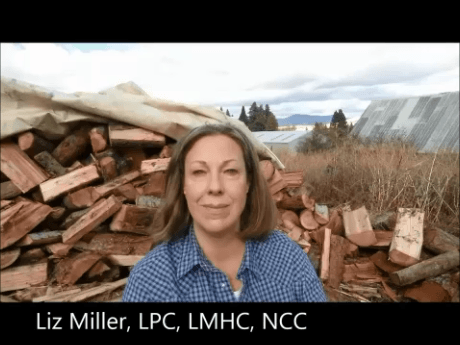
Hey everybody, Liz Miller here in Moscow, Idaho. I’m a marriage and trauma therapist. But, today I’m out here dealing with all of this firewood. Actually, it’s a tiny portion of my firewood for the year. It’s not exactly what I felt like doing today. What I really wanted to be doing was being curled up on the couch with my dog and a good book, maybe taking a hot bath, having a snooze, and really taking it easy. But, this firewood isn’t going to stack itself, as they say, and so part of what I needed to do for myself today was to get out here and plug away at it, so that when the snow flies I’m all set to go.

What is Self-Care?

And, it got me thinking about the nature of self-care, and the things we do to take care of ourselves. And, you know, sometimes it is curling up on the couch with a good book, or having a special date night with our spouse or partner, or really resting when we need to. That’s important. It’s also important, though, to do the things we need to do for ourselves. We need to stack firewood sometimes, or whatever your version of firewood is. Doing the things that set us up for the coming days, weeks, and months. Getting chores knocked out that will support the rest of our lives.

Sometimes Doing Chores is Self-Care

And, sometimes doing those things is self-care. So I don’t know what it is for you today, what your version of firewood is, or maybe it is a rest day for you. Whatever it is, I hope that you get just the right balance of taking really good care of yourself and giving yourself some TLC, and taking care of the things that you know help support you in your life.

Whatever it is, I hope you get what you need today, and thanks for watching!

Traumatic Grief: Trauma, Grief, or Both?

Traumatic Grief: Trauma, Grief, or Both?

Traumatic grief.

Traumatic Grief. Reading the two words together signals that something terrible happened. They highlight shock and suffering. Something happened to you suddenly, or was stripped away from you tragically. Perhaps someone even betrayed you unexpectedly.

Traumatic grief reveals distressing emotional injury and awful loss.

Now trauma lives in your mind and body along with your sorrow. Your thoughts and emotions can’t help but return to those events. Even sensations within your body hold reminders of what happened. And when you’re not re-experiencing it, your mind and body go numb.

Memories intrude and reoccur. Your body upsets, resets, and reacts. Now, loss is happening again and again inside you. Nightmares haunt your sleep.  Each time it’s real to you, and just as raw. Each time you hurt and are held back from the healing you hope for. Somehow, you just can’t get to the hope and help that painful but healthy grief eventually affords.

Why is it so hard?

Because unlike the road traveled by conventional grievers, your unprocessed trauma always takes priority, stifling a healthy journey through loss and acceptance back to your way forward in life.

So, how do you know when to seek help? How long do you grieve before you really know to reach out to a counselor rather than just family or friends? Are there signs you should look for? Are there questions to ask yourself?

Do you recognize these traumatic grief symptoms?

Grief and mourning are normal processes and responses to loss. As such, many find that the support of family, friends, or a non-profit grief group is enough. Even so, seeking extra support through counseling for a safe, confidential environment that’s all yours can aid many grievers.

But, you know it’s time to seek help when you experience these symptoms for more than a couple of months:

  • Frequent attempts to avoid any reminder or mention of the event or person,
  • A sense that the future is pointless,
  • Feeling numb or emotionally detached,
  • A persistent sense of being shocked or stunned,
  • Difficulty acknowledging and accepting the reality of the person’s death,
  • A sense that life is devoid of meaning or purpose,
  • Inability to even imagine a return to a full, rewarding life,
  • Feeling like part of yourself died, too,
  • Disrupted or disturbed sense of security, trust or control,
  • Identifying with damaging or harmful behaviors connected to the deceased person,
  • Anger, irritability, hostility, or bitterness,
  • Self-care seems useless,
  • Significant impairment of social, occupational, or other crucial functioning,
  • Nightmares or a sense of being disconnected from time.

(Of course, if you experience thoughts about self-harm or suicide, call 911, a 1-800 crises line, a counselor, family member, friend, pastor, or doctor.)

Do these symptoms seem familiar? Do you get the feeling they are not improving? Are you exhausted because your emotional pain is too difficult to tolerate and you can’t control the thoughts and images in your mind?

The neurobiology of trauma can seriously impair the ability to grieve in a healthful process. This is because trauma is the intrusion of traumatic events into the here and now, through thoughts and physical reactions, as though the events were happening again and again. To help you address your symptoms, you may need a trauma-informed grief counselor or trauma therapist who can help you consider and employ effective strategies for addressing the trauma first. Then they can help you proceed with grief processing afterward.

There is very little you can do to grieve effectively and completely until the traumatic impact to your nervous system is recognized, calmed, and corrected.

Is your brain struggling to recover?

We experience loss in a biological, physical, neurological, and emotional way. Hormones and chemicals are released, normal internal responses are disturbed, and key internal systems go on alert. A traumatic loss—traumatic grief—is intense. And the nervous system directs it all.

Your psychological responses to trauma tax the regions of your brain managing attention and memory. The areas that focus on emotion and relationships are overstimulated. The zones that are dedicated to planning and language are strained. Also, hormones reserved for emergencies pump through you too often. Your “threat assessment” center is in overdrive.

Thus, you likely cannot process your loss because it’s as if your thoughts and emotions are continually stuck on repeat. You are re-experiencing the traumatic events connected to the loss but not the return to calm and progress that eventually follows the grieving process.

“Grief,” for you, becomes a cycle of disproportionate, unrelenting, negative emotions, physical sensations, and thought intrusions. Your mind and body do the best they can. But, it’s rough trying to go on that way without knowledgeable help.

Is your support system supportive enough?

Sometimes, trauma survivors, or those experiencing loss in a dramatic manner, recover on their own. Especially if they have enough trusted friends or family who actively support them and come alongside them to grieve. Sometimes the trauma symptoms that accompany a traumatic loss will abate in a month or two.

But often, the need to discuss the circumstances and heartbreak of your loss repeatedly can prove too much for friends or family. Furthermore, to shore up more support, many find relief in grief support groups or online forums. However, there is much to be said for individual traumatic grief counseling to tease apart what constitutes the symptoms of healthy grief versus symptoms of posttraumatic stress.

If you sense you are not progressing through grief well, an objective perspective is often helpful amid the roiling emotions of your loss. In addition, a professional traumatic grief counselor can help determine whether your thoughts, emotions, and perceptions are grief with its normal stresses and sense of bewilderment, or whether lingering symptoms might indicate traumatic stress.

You’re hurting right now, maybe badly. And learning to live with your loss won’t be easy, and it will take as long as it takes in a process that’s individual to you and the relationship you have with whomever or whatever you lost. But, you can find help and relief if posttraumatic stress is compounding your suffering.

10 Things I Believe

10 Things I Believe

Not too long ago, I was challenged to come up with a list of 10 things I believe.  In addition to all the things I believe as part of my spiritual faith, the list that follows is the result of that challenge, on that given day.  I’m sure there are a lot more where these came from within my mind.  Take a look, and then consider what you’d write if someone challenged you.  Or, better yet, just pick up pen and paper, and see what your own list looks like when you start writing.

Here goes: 10 Things I Believe

  • I believe that a life of meaning and purpose can ease our way through the normal ups and downs of life, and through a whole lot more.
  • I believe that when clients understand more about their neurobiology and nervous systems as related to anxiety and trauma, shame is reduced and hope for healing increases.
  • I believe what Winston Churchill said.  “Success is achieved by going from failure to failure without losing one’s enthusiasm.”
  • I believe that you have a God-given “wow factor,” and that when combined with your unique story, it can enable you to touch the lives of others in a way no one else could.
  • I believe the best counselors have experienced counseling themselves and can remember what it’s like to be a client sitting down with a counselor for the first time.
  • I believe that quality of life is impacted by observing beauty, inhabiting peaceful space, accessing nature, and giving hope to others.
  • I believe that how we navigate times of unknowing has a profound impact on our lives.  There is no change without loss, and no loss without some grief.  Grieving is a natural and necessary part of processing change healthfully.  This includes the “down times” of the unknown.  The ebb is as crucial as the flow.
  • I believe we were created with a mind, body and spirit that are connected.
  • I believe we can relax into a lot of what happens and not force things to our will always.  We can live within the paradox of taking initiative while also waiting to see what develops.
  • I believe that courage plus support can change a life.

Now, what’s yours?

Learn a little about my story.