
Christian Marriage Communication Help for Repeated Conflict Cycles
If you and your spouse keep having the same argument—and it escalates quickly—you are not alone.
Many Christian couples describe a familiar cycle:
- A small issue turns into a heated argument
- One partner becomes defensive while the other pushes harder
- Someone shuts down, withdraws, or goes quiet
- The conversation spirals into disconnection
Later, these couples often wonder:
“Why does this keep happening if we both care this much?” Or, “Where does our peace go? These arguments definitely aren’t Christ-like!”
For Christian couples, there is often an added layer of desire:
We want to handle conflict in a way that reflects both truth and grace. But in real time, that balance can feel elusive.
Who This Marriage Counseling Topic Is For
This is especially relevant if:
- You’ve tried communication tools but still repeat the same arguments
- You can understand the problem after the fact—but not in the moment
- You value emotional connection and honoring God in your marriage
- You want to stop escalation without avoiding hard conversations
- You feel stuck in repeated conflict cycles in your relationship
These are common markers of couples who are thoughtful, motivated, and relationally engaged—but emotionally overwhelmed during conflict.
Why Arguments Keep Escalating
Most couples assume the issue is communication skills. Nearly every couple who reach out to me frames their issue in this way. “We need help communicating!” But, in the back of my mind, I’m thinking, “They need to understand how God made their brains and learn how their neurobiology affects their arguments.”
Research on marriage conflict and emotional regulation shows something more than a need for communication tools: when emotions rise, the brain becomes more reactive and less able to process communication clearly (Gottman, 1994).
This is often called emotional flooding in marriage, and it leads to:
- defensiveness
- withdrawal
- criticism
- escalation instead of resolution
Neurobiology and Arguing
When couples feel emotionally threatened, clarity decreases and reactivity increases. There are several parts of the brain that are the seat of interpersonal neurobiology. They make up what I call the “threat assessment center.” This is widely known as the Limbic System, and is made up mostly of the:
- Amygdala (assessing threats)
- Hippocampus (related to contextual memories)
- Hypothalamus (as well as the cingulate cortex, which helps connect emotion, thinking, and moods)
And, when that center is activated, it treats the threat of relational disconnection in the same way it would treat the threat of a grizzly bear on the trail in Glacier!
When the “threat assessment center” is truly activated, it inhibits the prefontal cortex which is largely in charge of things like working memory, emotional- and impulse-control, behavior, and the ability to stay flexible.
And, the part of the brain that registers emotional pain of rejection? That’s the same part of the brain that registers physical pain.
No wonder disconnection and arguing are so threatening to many Christian couples!
So, if during an argument you’ve ever:
- Had difficulty remembering the thoughtful or logical things you meant to say
- Found yourself remembering all the previous times this has come up despite not wanting to bring up the past
- Experienced a racing heart, flushed face, or unexpected tears
- Angrily blaming your spouse even though you promised yourself you wouldn’t
It’s almost certain that your “threat assessment center” has taken your prefrontal cortex hostage, when what you meant to do was use your will to “take every thought captive” as we are admonished to do in 2 Corinthians 10:5.
And, when that happens, many Christian couples spiral into shame because they want very much to be gentle with each other and experience Holy Spirit led self-control and the peace that passes understanding.
Christian Truth vs Grace in Marriage Conflict
Many Christian couples feel caught between two core aspects of godly communication:
- Truth in marriage communication → honesty, clarity, confrontation
- Grace in marriage communication → patience, kindness, restraint
This often leads to one of two patterns, or cycling through both:
- Over-talking and blaming (criticism, escalation, intensity)
- Under-talking and withdrawal (avoidance, silence, emotional distance)
But Scripture does not separate these values:
“The Word became flesh… full of grace and truth.” (John 1:14, ESV)
“Speak the truth in love…” (Ephesians 4:15, ESV)
Healthy Christian marriage communication requires both truth and grace working together in each spouse.
The Problem of Emotional Reactivity in Marriage Conflict
The core issue in escalating arguments is not lack of knowledge. Most of the Christian couples I work with want to reflect biblical character in their relationships, abide in Christ, and be formed by the Holy Spirit. Many are diligent in prayer and Bible study.
They want to be patient, kind, and self-controlled. They want to meditate on what’s good and be forgiving and forbearing. They want to grow in sanctification. Many become ashamed when they lose emotional regulation during conflict.
In family systems theory and marriage counseling research, one aspect of emotional regulation is called differentiation (Bowen; Schnarch). In my opinion, differentiation is a secular term for a spiritual reality.
Differentiation In simple terms:
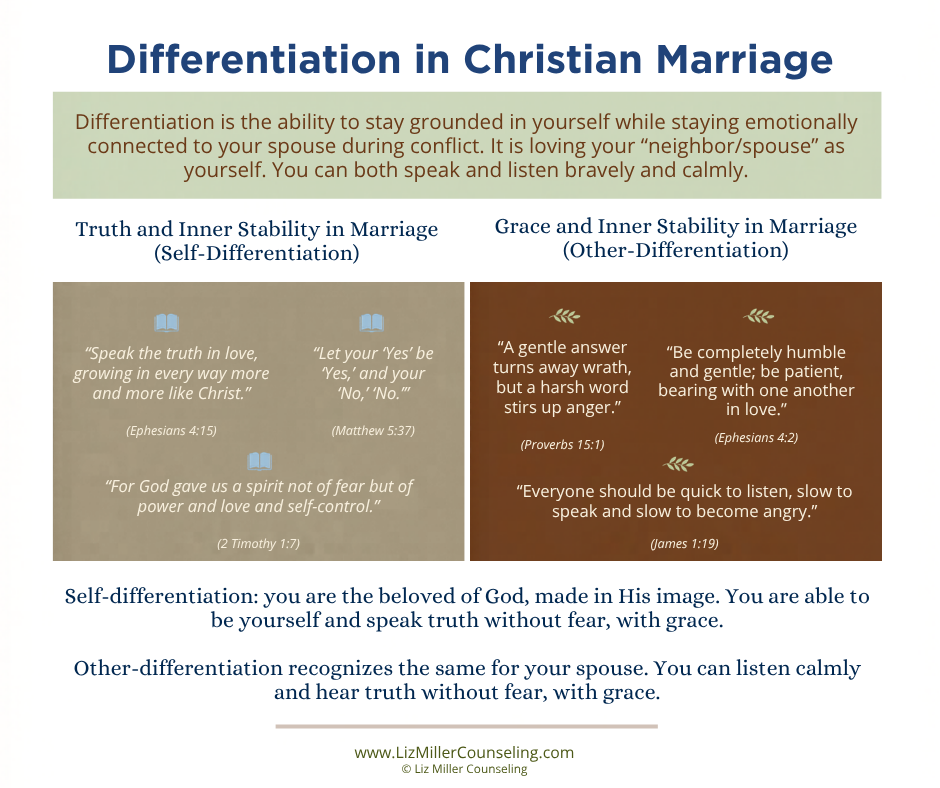
Differentiation is the ability to stay grounded in yourself while staying emotionally connected to your spouse during conflict. It is loving your “neighbor” (or spouse!) as yourself.
Self-differentiation recognizes that you are the beloved of God, made in His image, equal before Him, and equal in marriage. You are able to speak truth without fear, with grace.
Other-differentiation recognizes that your spouse is the same, and you are able to hear truth without fear, with grace.
Scripture reflects both sides of this differentiated maturity:
Truth and Inner Stability in Marriage (Self-Differentiation)
“Speak the truth with his neighbor…” (Ephesians 4:25, ESV)
“The truth will set you free.” (John 8:32, ESV)
“Am I seeking the approval of man, or of God?” (Galatians 1:10, ESV)
Grace and Emotional Regulation in Marriage (Other-Differentiation)
“Quick to hear, slow to speak, slow to anger.” (James 1:19, ESV)
“With humility, gentleness, and patience…” (Ephesians 4:2, ESV)
“A soft answer turns away wrath.” (Proverbs 15:1, ESV)
What Healthy Christian Marriage Communication Looks Like
Before (Escalating Marriage Conflict Cycle)
- “You never listen to me.”
- Interrupting or withdrawing
- Emotional escalation
- Reacting instead of responding
After (Grounded Christian Communication)
- “I’m feeling overwhelmed and defensive. I want to stay in this conversation, but I need to slow it down.”
- More self-awareness
- Lower emotional escalation
- Continued connection during disagreement
How to Stop Escalating Arguments in Marriage
(Practical Step)
When conflict begins to escalate, pause and ask:
- What am I feeling right now in this argument? Is anger hiding something more vulnerable?
- What is this really about underneath my reaction? Is it really about the topic, or am I feeling dismissed?
- What do I actually need in this moment? This is not a selfish demand, it’s self-examination.
- What might I hear from the Holy Spirit if I was calmer? Who am I called to be in this moment?
This interrupts the marriage conflict escalation cycle and restores clarity.
“Speak truth… that makes for peace.” (Zechariah 8:16, ESV). Of course, all of this is easier said than done, and if it was this easy, no one would be squabbling!
When I work with couples, I help them learn:
(1) How God made their nervous systems to function and how to rewire their automatic responses,
(2) How the neurobiology of our thoughts, feelings, and physiology can go sideways in this fallen world,
(3) Specific ways that they can create conflict-interrupters unique to them.
These methods support pastoral care and biblical principles rather than undermine them (a common worry). While the specific techniques go far beyond the scope of this article, it truly is possible to create new, godlier responses to interpersonal stress.
Christian Marriage Counseling Perspective on Conflict
Some couples unintentionally use faith to avoid conflict:
- “We shouldn’t argue as Christians”
- “We should just forgive and move on”
But biblical counseling emphasizes both:
- truth in marriage communication
- and grace in marriage relationships
“Correct with gentleness…” (2 Timothy 2:24–25, ESV)
Christian marriage health is not the absence of conflict—it is learning to engage conflict in a Christ-centered way. What does this look like? It can include:
- Calming your nervous system so that you can stay curious about what’s driving your spouse’s desires, reluctance, or decisions (other-differentiation).
- Using that calm state to speak thoughtfully in a timely way so that your spouse doesn’t have to guess at what’s going on with you (self-differentiation).
- Using principles from neurobiology (God’s creation) to help you obey Philippians 4:8.
When This Christian Marriage Approach Works Best and When Couples Need Additional Help
This approach is helpful if:
- You are experiencing repeated arguments in your marriage
- Both partners are willing to engage in change
- Conflict is emotionally intense but not unsafe
- You want to improve communication in your marriage
This approach may not be sufficient if:
- There is emotional or physical abuse
- One partner refuses all engagement
- There are safety concerns in the relationship
In those cases, specialized support is necessary.
What Changes in Christian Marriage Over Time
As couples learn to reduce emotional escalation:
- Arguments escalate less frequently. You both find more relaxation in day to day interactions. No one feels like they have to walk on eggshells or avoid important conversations. You spend more energy on loving each other as a team.
- Conflict recovery becomes faster. No more lost weekends (or trips, or events) because of one dust-up on Saturday morning.
- Communication becomes more stable. You build a track record of effective problem solving and mutual understanding.
- Emotional connection improves during disagreement. You might have differing perspectives to work through, but you don’t lose sight of the reasons you’re together.
The goal is not to eliminate marriage conflict—it is to transform how Christian couples handle conflict together.
Christian Marriage Communication Help: Final Thought
If you recognize your relationship in this pattern, you are not alone—and you don’t need to stay stuck in old cycles of disconnection.
Many Christian couples discover that the turning point is not learning more communication techniques, but learning how to stay grounded during emotional intensity.
As Christians, we are often warned against letting our emotions run the show. But, emotions really aren’t the problem; after all, God created them. Emotions provide very good information for us if we know how to listen to them and use them for His purposes (and that’s an article for another day!).
When we learn godly self-control over our nervous systems that is neither resentfully compliant shut-down, nor solely left-brain, logical analysis, then we can stay loving, truthful, kind, bold, curious, and patient during times of conflict. The counseling world calls this self- and other-differentiation. This is a part of mature sanctification. This is where truth and grace begin to function together in real Christian marriage communication.
Scripture References (ESV)
Proverbs 29:25; Proverbs 12:17; John 1:14; Ephesians 4:15, 4:25, 4:2; Galatians 1:10; John 8:32; James 1:19; Proverbs 15:1; Zechariah 8:16; 2 Timothy 2:24–25; Proverbs 13:3; Proverbs 25:12; Matthew 7:12; Romans 12:10; 2 Corinthians 10:5.
Clinical References & Research Foundations
- Bowen, M. (1978). Family Therapy in Clinical Practice.
- Cloud, H., & Townsend, J. (2002). Boundaries in Marriage.
- Gottman, J. (1994). What Predicts Divorce?
- Gottman, J. M. (2011). The Science of Trust: Emotional attunement for couples.
- Johnson, S., & Sanderfer, K. (2016). Created for Connection: The “Hold Me Tight” Guide for Christian Couples.
- Penner, D. (2014). Biblical Reference Guide for the Gottman Method.
- Schnarch, D. (1997). The Passionate Marriage: sex, love, and intimacy in emotionally committed relationships.
- Skowron, E. A., & Friedlander, M. L. (1998). Differentiation of Self Inventory (DSI).
Liz Miller, LPC – Licensed Professional Counselor in Idaho, LMHC – Licensed Mental Health Counseling in Washington. Serving residents of Idaho and Washington.